Home
/ Atom Economy Formula Chemistry : Question 7 1 8 Pts Part B Preparation Of Aspirin Chegg Com : The formula to calculate atom economy can be written in several different ways and they are all equivalent to each other because of the law of.
Atom Economy Formula Chemistry : Question 7 1 8 Pts Part B Preparation Of Aspirin Chegg Com : The formula to calculate atom economy can be written in several different ways and they are all equivalent to each other because of the law of.
Atom Economy Formula Chemistry : Question 7 1 8 Pts Part B Preparation Of Aspirin Chegg Com : The formula to calculate atom economy can be written in several different ways and they are all equivalent to each other because of the law of.. N = number of compounding periods each year. (atom economy) = d/ (d+c) Table 1 wittig reaction atom economy reactants utilised not utilised formula | chemical calculations | chemistry | fuseschoollearn the basics about the 'atom economy' in this video in our chemical calculation. You can do the calculation in any mass units you want, or non at all by simply using the atomic/formula masses of the reactants and products as appropriate , and i suggest you just think like that.
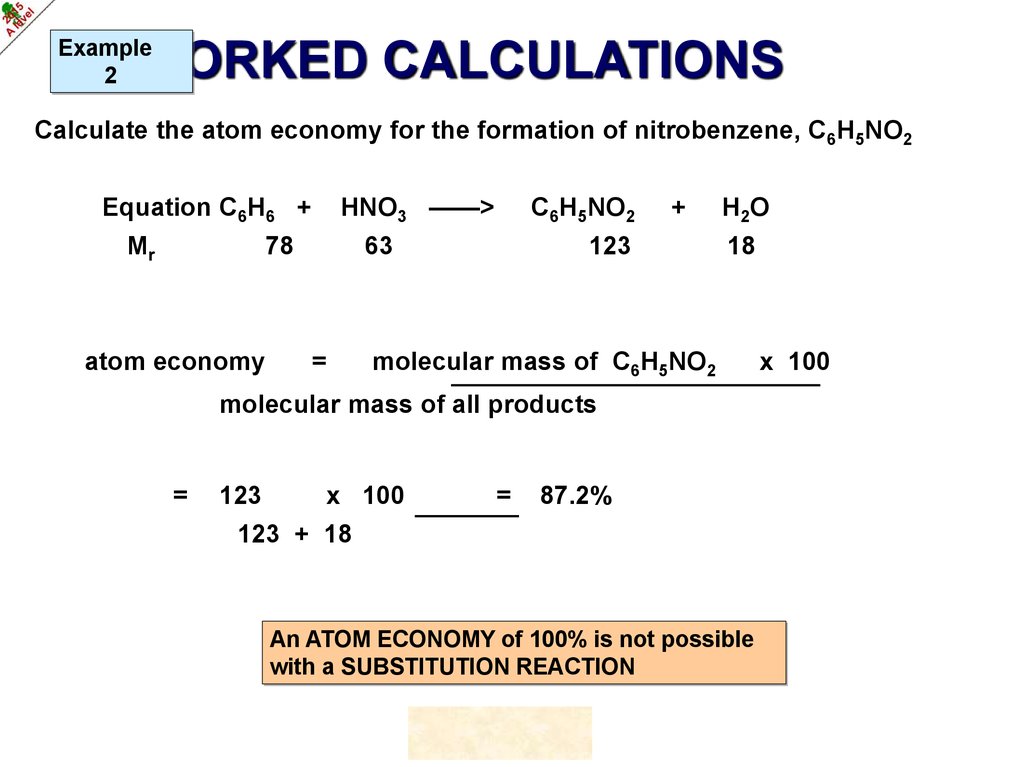
(a) calculate the atom economy and reaction efficiency of your synthesis. % atom economy = ` formula weight of the desired product/sum of formula weight of all the reactants used in the reaction xx 100`. Word and symbol equations, balancing equations, rfm calculations, % yield, % atom economy, % composition of element in a compound, empirical formula, solution calculations etc. Carbon monoxide is a waste gas. (b) describe some green features of your synthesis, and any that aren't so green.
The Ideal Gas Equation Online Presentation from cf.ppt-online.org Free chemistry revision notes on: Inspirational chemistry 167 green chemistry, atom economy and sustainable development the competing needs of development and environmental protection are often mentioned in the media and many students have opinions on the subject. The concept of the atom economy gives the measure of the unwanted product produced in a particular reaction. E factor (environmental factor) is another simple metric of how green a reaction is. It is important for sustainable development and for economic reasons to use reactions with high atom economy. In this reaction, carbon and oxygen atoms in the reactants do not form the useful product. Atom economy = \ (\frac {\textup {total m}_ {r} \textup { \\ of the desired product}} {\textup {total m}_ {r} \textup { \\ of all reactants}}\) × 100 the highest possible value of atom economy is. Percentage yielda number between 0 and 100 to show how successful the practical work has been at producing the desired product.equation:
For the general chemical reaction:
| chemical calculations | chemistry | fuseschoollearn the basics about the 'atom economy' in this video in our chemical calculation. A + b → p + x p + c → q + y q + d → r + z. (b) describe some green features of your synthesis, and any that aren't so green. The simplest definition was introduced by barry trost in 1991 and is equal to the ratio between the mass of desired product to the total mass of products, expressed as a percentage. Atom economy (atom efficiency/percentage) is the conversion efficiency of a chemical process in terms of all atoms involved and the desired products produced. % atom economy = (fw of atoms utilized/fw of all reactants) x 100 = (137/275) x 100 = 50% thus at best. Atom economy is defined as the conversion efficiency of a chemical process, in terms of all atoms involved and the desired products produced. The conservation of mass principle. As shown below this reaction has only 50% atom economy. Reactants desired product + waste products. Chemistry ideal of atom economy 5. Table 1 wittig reaction atom economy reactants utilised not utilised formula It is a theoretical value that provides another way to evaluate a reaction process, alongside yield and efficiency.
Find my revision workbooks here: Table 1 wittig reaction atom economy reactants utilised not utilised formula Word and symbol equations, balancing equations, rfm calculations, % yield, % atom economy, % composition of element in a compound, empirical formula, solution calculations etc. Atom economy = \ (\frac {\textup {total m}_ {r} \textup { \\ of the desired product}} {\textup {total m}_ {r} \textup { \\ of all reactants}}\) × 100 the highest possible value of atom economy is. Inspirational chemistry 167 green chemistry, atom economy and sustainable development the competing needs of development and environmental protection are often mentioned in the media and many students have opinions on the subject.
10 Atom Economy Sjp1618gcsechem from sites.google.com For the general chemical reaction: Atom economy = \ (\frac {\textup {total m}_ {r} \textup {of the desired product}} {\textup {total m}_ {r} \textup {of all reactants}}\) × 100 the atom economy of a reaction is 100% if there are no. The atom economy (atom utilisation) of a chemical reaction is a measure of the percentage of the starting materials that actually end up in useful products *. (a) calculate the atom economy and reaction efficiency of your synthesis. Atom economy in a snap! The atom economy is calculated by. Chemistry ideal of atom economy 5. At the very base of a chemical reaction, there are atoms that are being.
Table 1 wittig reaction atom economy reactants utilised not utilised formula
| chemical calculations | chemistry | fuseschoollearn the basics about the 'atom economy' in this video in our chemical calculation. Atom economy in a snap! Reactants desired product + waste products. Chemistry calculations percentage yield atom economy. (atom economy) = d/ (d+c) Operational organic chemistry (4th edition) edit edition solutions for chapter 34 problem 4e: 4.3.3 yield and atom economy of chemical reactions. Percentage yielda number between 0 and 100 to show how successful the practical work has been at producing the desired product.equation: Percentage yield and atom economy show how much desired product is obtained compared to amounts of starting materials. At the very base of a chemical reaction, there are atoms that are being. Find my revision workbooks here: It is a theoretical value that provides another way to evaluate a reaction process, alongside yield and efficiency. The formula to calculate atom economy can be written in several different ways and they are all equivalent to each other because of the law of.
Atom economy = \ (\frac {\textup {total m}_ {r} \textup { \\ of the desired product}} {\textup {total m}_ {r} \textup { \\ of all reactants}}\) × 100 the highest possible value of atom economy is. Atom economy was designed by barry trost as a framework by which organic chemists would pursue greener chemistry. The atom economy number is how much of the reactants remain in the final product. A selection of worksheets together with answer sheets which are aimed at chemistry students for use in class. Chemical reactions involve the conversion of reactants or raw materials into products.
Atom Economy Calculation Sustainable Refashioned Design By Buddha Jeans Sustainable Refashioned Design By Buddha Jeans from buddhajeans.com The concept of the atom economy gives the measure of the unwanted product produced in a particular reaction. The atom economy of a reaction is a measure of how many reactant atoms. Gas calculations show volumes of gas used and obtained in chemical reactions. Atom economy = \ (\frac {\textup {total m}_ {r} \textup { \\ of the desired product}} {\textup {total m}_ {r} \textup { \\ of all reactants}}\) × 100 the highest possible value of atom economy is. Carbon monoxide is a waste gas. Is a way to measure the amount of useful product. Chemistry calculations percentage yield atom economy. Atom economy is defined as the conversion efficiency of a chemical process, in terms of all atoms involved and the desired products produced.
The formula to calculate atom economy can be written in several different ways and they are all equivalent to each other because of the law of.
The percentage atom economy can be calculate by taking the ratio of the mass of the utilized atoms (137) to the total mass of the atoms of all the reactants (275) and multiplying by 100. As shown below this reaction has only 50% atom economy. Atom economy in a snap! Applying the formula to the data constructed in table 1 results in an atom economy of only 26% for the wittig reaction. It is defined as the ratio of the mass of waste per mass of product. Carbon monoxide is a waste gas. Table 1 wittig reaction atom economy reactants utilised not utilised formula Reactants desired product + waste products. The atom economy (atom utilisation) is a measure of the amount of starting materials that end up as useful products. For the general chemical reaction: Find my revision workbooks here: % atom economy = mass of wanted product(s) x 100 The conservation of mass principle.
It is defined as the ratio of the mass of waste per mass of product atom economy formula. E factor (environmental factor) is another simple metric of how green a reaction is.